Which Finance Certifications Actually Matter in the 2026 Job Market?
The financial sector of 2026 is no longer defined by simple arithmetic or traditional ledger management. We are operating in a post-AI landscape where “commoditized knowledge” is handled by algorithms, leaving the high-stakes decision-making to a new breed of certified professionals. For students and mid-career pivots, the question isn’t just about adding letters to a LinkedIn profile—it’s about which credentials offer a measurable Return on Investment (ROI) in a volatile economy.
As academic requirements for these certifications become increasingly quantitative, many candidates are finding that the gap between university theory and professional application is widening. It is common for top-tier aspirants to seek finance homework help to master the advanced stochastic modeling and Bayesian statistics that now dominate the Level I and Level II curricula of major global certifications. This foundational mastery is the “silent” prerequisite for success in 2026.
Whether you are aiming for a role in a New York hedge fund or looking for assignment help London to stabilize your MSc in Finance grades, the following certifications represent the elite tier of 2026 employability.
1. The CFA (Chartered Financial Analyst): The AI-Hybrid Evolution
In 2026, the CFA remains the “Gold Standard,” but with a massive caveat. The CFA Institute has fully integrated “Data Science and AI for Investment Professionals” into all three levels.
- Why it matters: It proves you can oversee AI-driven portfolios. Hiring managers are no longer looking for people to build models from scratch; they want analysts who can audit and interpret AI outputs.
- The Data: 2025-2026 salary surveys indicate that CFA charterholders earn a 24% higher median salary than their non-certified counterparts in investment roles.
2. The FRM (Financial Risk Manager): Navigating the Polycrisis
The mid-2020s have been defined by “polycrisis”—simultaneous shocks in climate, geopolitics, and cyber-infrastructure. The FRM designation, offered by GARP, has seen a 15% surge in demand as banks scramble to manage decentralized finance (DeFi) risks.
- Key Focus: Stress testing, liquidity risk, and non-financial risk (NFR) management.
- Market Value: In the US, FRM holders are currently prioritized for “Chief Risk Officer” (CRO) tracks, particularly in the fintech and insurance sectors.
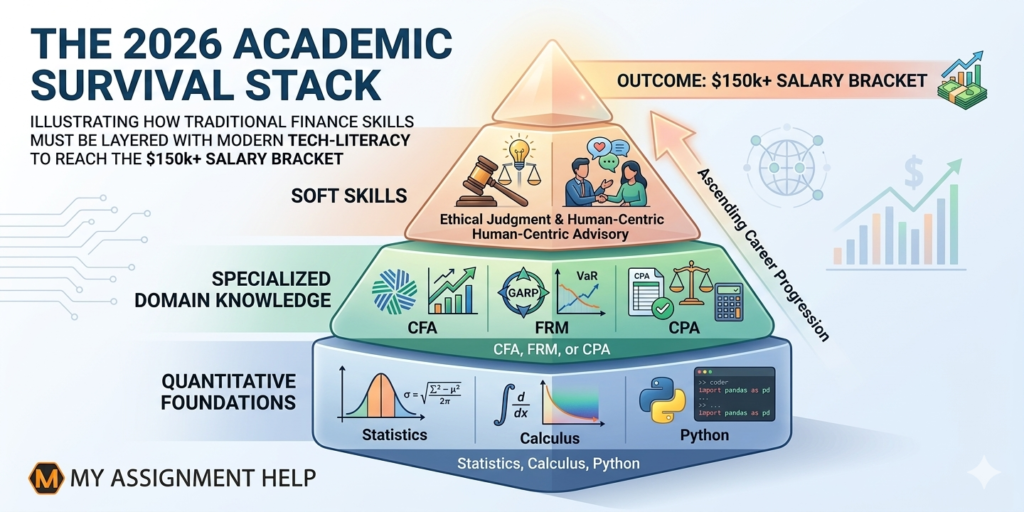
3. The “Academic Survival Stack” (Infographic Concept)
4. ESG Investing: The New “License to Play”
Environmental, Social, and Governance (ESG) certifications have moved from “nice-to-have” to a mandatory requirement for institutional asset management. In the US, new SEC disclosure mandates in 2025 have made the CFA Institute’s Certificate in ESG Investing the fastest-growing credential in the country. decoratoradvice, impocoolskin, kathleen nimmo lynch
Key Takeaways for 2026
- Niche over General: General finance degrees are losing value compared to specialized certifications.
- Tech Integration: If a certification doesn’t include data visualization or Python, it is likely becoming obsolete.
- Global Mobility: The CFA and FRM remain the most portable certifications for those looking to move between the US, UK, and Asian markets.
Frequently Asked Questions (FAQ)
Q: Is a CPA better than a CFA in 2026?
A: It depends on your goal. The CPA remains superior for tax, audit, and corporate controller roles. The CFA is the undisputed winner for asset management and equity research.
Q: How has AI affected the difficulty of these exams?
A: The math hasn’t changed, but the application has. Exams now focus less on rote memorization and more on complex, multi-variable case studies that require “human-in-the-loop” reasoning.
Q: Can I study for these while working full-time?
A: Yes, but it requires roughly 300-400 hours of study per level. Leveraging academic support for the more technical modules (like derivative pricing or fixed income) is a common strategy for working professionals to save time.
Author Bio: Dr. Alistair Vaughn
Dr. Alistair Vaughn is a Senior Content Strategist and lead Academic Consultant at MyAssignmentHelp. With a PhD in Quantitative Finance and over a decade of experience coaching CFA aspirants in the US and UK, Dr. Vaughn bridges the gap between professional rigor and student success. He is currently focused on developing AI-integrated curricula that align with E-E-A-T standards for the global education market.
Sources & References
- Global Financial Talent Trends Report 2026.
- CFA Institute: “The Future of Professional Education” (March 2026 Update).
- US Bureau of Labor Statistics: Occupational Outlook for Financial Analysts (2025-2035).
- London Stock Exchange Group: “The Rise of Green Finance Credentials.”